Sunday, December 11, 2022

The Worms Crawl In

 https://moviesandmania.com/wp-content/uploads/2017/04/the-worms-crawl-in-song.png

Dusty Creek was a dried-up old town. It had been small since its inception, and smaller still since the draft had begun. You could run in to everyone you knew within the space of one hot afternoon, and by God, you knew everyone. You knew friends, and you knew enemies, and from day to day it was hard to tell the difference. At least, this was the case for young Billy Monroe.

Billy was a washed-out, pale-haired eleven-year-old boy, the runt of a pack of four local lads. The four boys, all roughly the same age, generally ended up playing together – not because of any particular fondness for each other, but rather that in a town of that size beggars could not be choosers. Because of this, the line between play and bullying was a vague and often unimportant concept.

The boys usually merged together in the town square. There was nothing to draw them there other than convenience. No butcher, baker, or candlestick maker – just a grocery of dwindling stock, an unfrequented haberdashery, and some faded posters advertising the benefits of a victory garden (a hopeless endeavor in Dusty Creek) and a woman declaring that we can do it (equally hopeless as there was nothing to do).

They had passing phases of interest, generally led by the whims of one Caleb Jacobs, a medium-sized, freckle-faced boy who was the unspoken leader of the pack. One month it was jacks, another month cards (though this was quickly put to an end by the hen-like ladies passing by, convinced that the boys were playing that morally corrupting game called poker). After that there came pirates, followed by jungle adventurers. These phases would always come on suddenly, only to snuff out just as quickly

All, that is, except marbles.

Who knows why marbles was a permanent fixture of the group – it simply was. A game could break out at any time, so the boys always carried their leather sacks of marbles. They generally didn’t play for keeps, as the boys wished to hold onto their own meager collections, though Caleb could sometimes convince them to risk losing their cherished marbles with a rough and condescending tone.

Billy Monroe was especially attached to his collection. Or rather, to a single large shooting marble.

It was a true prize – a two-color spiral snake marble, with twists of oxblood and pearly mint coiling just under the clear glass surface. It was miles above the others’ simple single colored agates and scavenged ball bearings.

It was a hot afternoon, just like every afternoon, when Caleb decreed a game of marbles. With some judicious brow-beating, he was also able to persuade the pack into playing a game for keeps.

A playing circle was quickly scratched into the dirt, and the boys were now carefully choosing which of their own marbles they might be willing to sacrifice. When Billy Monroe pulled his jewel of a marble out of his sack, he gave the marble a comically exaggerated kiss for good luck before nestling the treasure beside him in the sandy soil – well outside of the bounds of the circle.

Roy Jones, a broad, thick lipped boy with hands the size of pan lids, sneered at him.

“Why do you keep that ol’ shooter even though you never use it?” he drawled. “Doesn’t make sense.”

“What are you talking about?” said Billy. “I use it all the time.”

Roy clicked his tongue. “You know what I mean, when we play for keeps, like we’re doing now.”

“Well it’s lucky! It’s always been lucky. No sense in the world sending you some luck if you’re only going to give it away right back.”

Roy pouted. “I’m just saying that it’s not fair that you don’t use that shooter when we play for keeps,” he spat out.

Billy scowled. “How’s it not fair? I’m not breaking any rules using a different shooter. We can use whatever we want. Right, Caleb?”

Caleb nodded sagely, leading to a round of snickering.

“Roy just wants it for himself,” laughed Matt, a black haired string bean of a boy. “I don’t think you’d risk that marble either if you had it, Roy.”

Roy huffed at this call out. “That’s bullcrap, and you know it,” he growled. “Who would want that fussy old marble anyway? It’s just a stinking snake marble. Who wants those?”

Roy grinned darkly at his new train of thought. “Know what?” Roy jeered. “I bet those aren’t even snakes. You know what those colory bits looks like to me? Worms. Wriggly, crawly, slimy worms.” Roy barked a cold laugh. “Do you love worms that much, Billy? Like your gramps? I bet your gramps looooves worms. Comes home covered in them from shoveling worm food all day. Just can’t get enough of them.”

Old Man Monroe, Billy’s grandfather, was the local gravedigger, a taciturn, long-faced man who seemed more at ease among the silent dead than his neighbors.

“Why do you keep itching for this damn marble, then?” said Billy. “I thought you hated worms. Or maybe you want to eat it? Can’t forget that yummy sandwich? Does Roy want a widdle snack?”

“Stop it!” Roy spat through gritted teeth, yet even as he spoke his insides spasmed. Roy’s stomach couldn’t help but roil at the memory, and the other boys laughed richly as he burned red from anger and embarrassment.

Last spring, the group had chosen to bring lunch pails to school in order to play jacks during the midday break. Caleb had deigned to offer Roy half of his ham sandwich, knowing that the quickly bulking boy couldn’t refuse a chance at rationed meat. Roy had eagerly chomped off a large, ravenous bite.

Within one chew, Roy realized that had been bitterly deceived, as a slimy, earth tasting paste gummed itself between his teeth. He dropped the sandwich, and as he gazed down he saw bits of worm fall onto his chest and stomach and the sandwich contents writhing and wriggling where they lay.

He had screamed so loudly that he attracted the attention of the entire square, from the busy shop keeper, to the hen hatted ladies, and even to Old Man Monroe, shuffling about doing rare errands that required personal interaction.

With some deep breaths and a careful swallow, Roy brought himself back to the present. The churning in his stomach morphed into a burning bilious fire.

“Well that marble didn’t do your Pa any good, did it?” he hissed. “That lucky marble. Bet it’s cursed. I bet your old gramps hates himself for giving it to him.”

“It’s not cursed!” shouted Billy, his face scrunched up and red. “And it was lucky! At least Pa came back to be buried in one piece. That’s more than you can say for your uncle,” he jeered. “Bet he wasn’t even blown up. Bet it’s a lie, that he ran off with some French floozy-”

Roy launched himself at Billy, punching him square in the jaw. It took a moment for Billy to recover, but he quickly hunched over and drove his shoulder into Roy’s stomach like some kind of crazed berserker. The movement forced a spat of bile up into Roy’s mouth, and he gagged as he fell hard onto his rear. The rest of the boys burst out laughing.

“Okay, okay, settle down, guys,” said Caleb, after he had had his fill of derisive mirth. “Roy, you shouldn’t have said that about his marble, and Billy, you shouldn’t have said that about his uncle. Truce, ok?”

Billy toed the ground. “Yeah,” he mumbled, “I guess.”

“Roy?”

Roy was still coughing on the bile in his throat.

“Well, whatever. C’mon guys, let’s get out of here.”

As the rest of the pack shuffled away, Roy had managed to right himself. He brushed dirt off of his face with the back of his hand.

“I’ll kill you, Billy Monroe,” he growled. “I’ll kill you.”

* * * * * *

A week had passed, and another game of marbles had begun.

All resentment over the argument seemed to have been erased and written over with other petty squabbles and name calling.

The pack was once more gathered in the square, squatting by a circle of iron railing meant to protect the scorched and withered sapling inside of it. The railing was being used as a makeshift prison camp, a mighty fortress housing sun-bleached clothes-pin POWs. Their comrades had planned a rescue, but sadly they had all collapsed on the field of battle when Caleb demanded a game of marbles. What’s more, another game for keeps.

The boys reached for their leather sacks and emptied their contents onto the dirt. Once more, Billy took the beautiful marble and gently placed it at his side, safe and sound.

The bitterness that Roy thought he had forgotten bubbled up, and he grabbed the marble where it lay nestled next to Billy.

“You’re going to use it this time! Show us just how lucky it is!”

Billy squealed and grabbed at Roy’s wrists for the marble which he held aloft. When the side of Billy’s fist planted itself into Roy’s chest, Roy lost himself completely and shoved Billy hard.

What happened next was an accident. A solid plant, perhaps accompanied with a thump on the head, then running off in tears, and that should have been the end of it. That was supposed to be the end of it. But the luck of Billy’s marble soured that day. In one stumbling step backward, Billy’s foot landed on a cluster of marbles, sending him careening in a violent arch. In his fall, Billy struck the iron tree guard and landed in a heap on his side.

The boys were laughing, and as their guffaws turned into big huffs of steadying breath, they began to wonder at Billy’s stillness.

“Billy,” said Caleb, “stop playing possum.”

“You can get up now Billy, don’t be such a baby.”

The commentary hushed as they noticed a trickle of blood coming from his ear, and soon another streaming down his nose.

They didn’t move, they didn’t speak. They could only watch as Billy lay lifeless, his skin, shirt collar, and even the soil around him became stained with red.

The shopkeeper was the first adult to notice, as he had seen the fight and had stomped down the square to break it up. Upon seeing the scene before him, he let out a loud yell. A commotion was soon started, with some people shouting about the need for a doctor and others shaking their head over the mysterious whims of the good Lord.

As the adults crowded in, the boys were pushed away, as empty and dumb as the body crumpled on the ground.

* * * * * *

A brief inquiry had been held, and while Roy was subjected to the stern looks and long-winded scolding of the town doctor, it had been decided that Billy had died by Misadventure. Two days later, the town gathered to see Billy off to his final resting place. Old Man Monroe was not rich, thus Billy’s coffin was a simple pinewood box. The large nails splintered the wood around the place they had been hammered in, contributing to a vaguely warped and weak appearance. Monroe sat next to it, a gentle hand resting against it protectively as his neighbor’s rusted old cart, used in place of a hearse, trundled down the dirt road to the graveyard. Men had their hats off, women daintily dabbed at the corners of their eyes with their handkerchiefs.

Children were there as well, many of them bored or confused.

Roy was standing next to Matthew, the weakest of the group now that Billy had passed.

“I don’t get why we need to stand here and watch,” muttered Roy with a scowl. “I mean, we already know he’s dead, why do we need to look at his box?”

“It’s respectful, I guess,” mumbled Matthew, though he seemed unsure in the face of Roy’s strong opinion.

Roy suddenly grinned.

“Hey Matt,” he whispered conspiratorially. “Look what I got.”

Roy opened his clenched hand to reveal Billy’s spiral snake marble.

Matthew gasped.

“Roy!” he hissed in a frantic whisper. “You can’t keep that!”

“What do you mean?”

“You should give that back to Old Man Monroe, it’s important to him-”

“You’re talking horseshit,” hissed Roy. “It’s not like he plays marbles. He’s too busy messing around with worm food all day.”

“But,” said Matt weakly, “it belongs to their family-”

“Not anymore, Matthew,” said Roy. “I grabbed it fair and square.”

“Wait, did you take it when he died?”

“Sure,” Roy shrugged. “He wasn’t going to use it anymore.”

Matthew’s mouth hung agape.

“What’s the big deal? He was already dead; there wasn’t anything we could do to help him.”

“I mean, sure I guess, but still-”

“You gonna squeal on me?”

“N-no,” muttered Matthew, eyes downcast.

“That’s what I thought.”

There was suddenly a commotion. The wheel of the old cart had hit a rock, and the rickety old thing broke. The coffin slipped from the suddenly tilted floor, causing a splintery dent at the head.

Amid the panicked and concerned shouts of the adults, and as Old Man Monroe gazed helplessly into the crowd, Roy simply threw his head back and laughed, the marble twinkling in his hand.

* * * * * *

Some days had passed, and Roy found himself alone in his small attic room. Watery moonlight streamed through the window, and outside there was nothing to hear but the chittering cicadas and the occasional mournful hoot of an owl.

His mother would whip him if she knew that he hadn’t yet gone to sleep, but she was visiting her sister the next town over, and Roy simply couldn’t stop admiring his ill-gotten treasure.

He cradled it in his palms, feeling the slight chill of glass warm as it absorbed his heat. He held it in one hand, opening it flat so that the marble could roll gently over his skin. He held it between his fingers, angling it into the moonlight, thrilling at the rich glow of the colorful snakes inside.

Roy was only dimly aware of the heavy flap of wings and a sudden lull in the cicadas’ cries, but his attention was soon grabbed when he heard a noise alien to his usual experience. It was a faint, metallic snik.

What kind of sound could that be? he wondered. It seemed to have come from outside.

He pressed his face against his window, the glass becoming damp under the steam from his nose. At first he found nothing amiss, but then he saw something that made his heart drop. From his perch, he could just make out the flung open cellar doors, the old rusted chain which usually kept the doors closed flung carelessly aside.

As Roy puzzled blankly over this oddity he heard a sudden creak in the floorboards downstairs. His blood chilled, and for a long time he remained frozen. The steps continued, each tread sending a new shiver of panic up his spine. His hand began hurting, and he realized that he was clutching the marble so hard that his nail beds had turned white.

He stared at the marble in horror as a sudden realization came over him. The marble. It must be the marble. Billy had come back for it. How soon would it be before he ascended the stairs and crept into his room? All manner of folk tales and ghoulish myths flooded him.

Within a few minutes, though, the tread ceased.

Billy knew where his room was, and would know where to look for him. Roy swallowed hard as he realized that he needed to make an escape.

Roy winced at the creak of his door hinge. Poking his head out carefully, he didn’t see anything in the cramped hall. He carefully walked down the stairs, counting ten heart beats before silently shifting his foot onto the next step, a process which was becoming faster as his heart rate began to rise.

There weren’t any apparitions or ghostly moans. Maybe he could make it? He could go to the neighbor’s house and say there was a snake…

He reached the bottom of the stairs. Roy held his breath until it burned, attempting to guess at which floorboard would creak the least. He eventually screwed up his courage and pressed his toes forward, preparing for a whip crack to sound in his ears.

Roy was puzzled when no betraying noise came, but then horrified when he realized why. Instead of hitting the bare wood he expected, Roy had stepped into a squish of soft ground. A freezing coil of terror slithered up his spine as he tried to identify the substance. All manner of wild, nightmarish guesses sprang to mind, but it was a patch of watery moonlight by an uncurtained window that revealed the truth.

Soil.

Once the realization hit, it was followed by an overwhelming stench. Somehow fear had blocked it from him, but now was practically holding Roy’s face into it. It was dead earth – a sickening combination of wet stone and rotting weeds.

Roy’s eyes roamed helplessly, and a pale wash of moonlight revealed the true horror. Trails of dank soil lead all over the house. Chunks of it, skids of it. All of it reeking of the grave.

Roy started to cry.

“I’m sorry, Billy,” he wept. “I’m sorry! Here – you can have your marble back. Is that what you want? It’s yours! I’m sorry!”

He held out the marble into the shadowy emptiness in cupped, trembling hands, hot tears dripping down his cheeks.

A dark, dirt-covered shadow rose over him. Roy gasped, burning and dry, just before a shovel bashed over his head, stamping out his short, miserable life.

* * * * * *

Old Man Monroe trod silently up the path to the graveyard. He was a strong man, and his burden was light on his shoulders. He soon reached his goal – a yawning hole rimmed with damp earth. Monroe was used to moonlight and had decided not to use a lantern. He gently slid down the side of the hole, gingerly placing his feet between the wall of wet earth and the pinewood box before removing the loosely nailed lid.

“Here you go, Billy.” The old man slid the marble into a gap between Billy’s stiff fingers, so that he appeared to be fondly holding it close. To the old man, it seemed that a small smile briefly ghosted over Billy’s lips before resuming their restful state.

He carefully climbed out of the hole after gently placing the lid back on, then once more scattered dirt onto the coffin with somber serenity.

He did not fill it up, however. There was yet one more thing to be done.

He roughly tossed a bloody mass into the hole. It was Roy, his mouth agape, his brains spilling out of his broken skull.

The old man reached into his pocket, ready to give another treasure.

Worms. Worms everywhere. He had spent hours plucking them from the damp earth, cooing at them with promises of a grand feast. He scattered them over the entire length of Roy’s body. Already they were wriggling and poking at the still-warm flesh, with one particularly curious specimen slowly burrowing into the pink pulp at his scalp.

As a final touch, the old man stuffed a handful into Roy’s open mouth. He spit upon the corpse, then cackled with a final departing message.

“Enjoy your meal, Roy.”

----

 Written by Gabriel Black

My Brother’s Keeper

 https://media.thegospelcoalition.org/wp-content/uploads/2018/03/21190207/brothers-keeper-1920x820.jpg

My brother and I were always close. He was extremely shy. He never invited over friends and he always stayed in our room.

Growing up, our parents were dirt poor. After third grade, we moved into a basement my parents rented. This meant that Erik, our parents, and I had to share one room. One bed for us, one bed for our parents. I never minded it, but Erik seemed to. It was around here that he started to change.

Mom and Dad sold a lot of our stuff to make ends meet. Erik got it the worse. Pretty much everything of his was sold. His bed. His favorite comic books. Half his clothes.

I offered to share my bed with Erik, but he always refused. He said he had trouble sleeping at night. I asked him why once, and he told me that he was afraid of dying. He heard stories of people falling asleep and never waking up again. He didn’t want that to be him.

I tried telling him that he shouldn’t be afraid. We would watch over each other. He would always refuse. “I’ll watch over you,” he insisted. I would argue, but I was never able to stay awake long enough for him to fall asleep.

I felt bad for him. We weren’t in any of the same classes. He never spoke to either of our parents and wouldn’t meet any of my friends. He said he only cared about me. “We’re brothers,” he explained. “I just want to hang out with you.”

It all changed when we graduated. I got accepted into our state school, while Erik didn’t even bother applying. It was then that I realized Erik wasn’t the same brother I grew up with. Instead of trying to get out of poverty, he was going to rot away at home.

I told him he was going to end up like our parents.

He didn’t respond, only watched as I loaded my truck and drove away.

I really regret it. I shouldn’t have said that to Erik, and I plan on making it up to him. Now that the semester ended, we can finally get back in touch. I bought all of his favorite things. His favorite movies. His favorite cds. I even managed to hunt down copies of the old comics Mom and Dad sold.

As soon as I got home, I noticed something was off. Erik wasn’t there. I asked my mother where he was, and she immediately started crying. I asked Dad, and he told me to get out of their home and never come back. I couldn’t figure out why until I got a call three days later.

It was my father. He said he was concerned that my countless voicemails asking about Erik wasn’t a joke. And that’s when I got the truth.

Erik and I went to the park in the third grade. Only I came home. 

---

Credits

My Brother Died Last Week, Today I Found A Note That He Wrote

 https://images-wixmp-ed30a86b8c4ca887773594c2.wixmp.com/f/8da56ed5-b5f8-4c83-a29f-9649f6d26dd0/d1lnw2i-9797e818-1195-478c-b041-761115ff10bf.png?token=eyJ0eXAiOiJKV1QiLCJhbGciOiJIUzI1NiJ9.eyJzdWIiOiJ1cm46YXBwOjdlMGQxODg5ODIyNjQzNzNhNWYwZDQxNWVhMGQyNmUwIiwiaXNzIjoidXJuOmFwcDo3ZTBkMTg4OTgyMjY0MzczYTVmMGQ0MTVlYTBkMjZlMCIsIm9iaiI6W1t7InBhdGgiOiJcL2ZcLzhkYTU2ZWQ1LWI1ZjgtNGM4My1hMjlmLTk2NDlmNmQyNmRkMFwvZDFsbncyaS05Nzk3ZTgxOC0xMTk1LTQ3OGMtYjA0MS03NjExMTVmZjEwYmYucG5nIn1dXSwiYXVkIjpbInVybjpzZXJ2aWNlOmZpbGUuZG93bmxvYWQiXX0.br-Z1qRZMo7lLKpt7CTF53nRiyTsk1ZZLtYVrLPxvko

This is my last attempt at writing this post. I just need help getting closure. If anyone can help that would be amazing.

My brother killed himself a week ago, today I found his suicide note.

It has been a week since Sam died. Mom and dad haven’t been the same. Sam was there golden child, the kid that I couldn’t be. Don’t get me wrong though, I wasn’t jealous. I love being me.

Sam was so innocent. He couldn’t hurt a single thing on this world. He was 13. They called it a suicide and said that he was depressed. I’m not convinced that it was though. You see, Sam was a happy kid. He was your average kid. He played video games, played sports, had a lot of friends. There was nothing for Sam to be sad about.

He was fine up until December. Usually he loves December, but this year he was different. Around the 3rd of December he started acting weird. He wasn’t the same kid that I knew. He wasn’t the same kid that mom and dad knew. We all noticed the change. He went from being happy and always being very talkative to seeming sad and not talking at all.

He would always pick at his food and wouldn’t eat a lot at dinner. We asked what was wrong and he said “fine”. We knew he was lying. Fine is the worst word in the English language. It is so misused. When someone says they are fine, they aren’t. They say that to stop the conversation. They say that so they don’t have to talk about how they really feel.

Sam wasn’t fine. That much was very obvious. Mom said to leave him alone though, that maybe it was puberty. I didn’t think so though. I’m 16 now and, well, I didn’t act like that when I was 13. His mood change was so sudden. He went from being joyous and happy to being sad and well, depressed. I hate that word.

I’m not sure if Sam was depressed. I’m assuming he was, but I don’t know for sure. All I know is that I miss him. He was my best friend. I didn’t have a connection with other people like how I did with Sam. Sam truly was my best friend. Sure I had friends at school, but Sam and I had a special bond. A bond that only brothers could have.

My favorite memories with Sam is when we would go to the lake and build forts. We still did that even when we grew up. It was fun for us. We always had a special bond and that was our way of bonding even more. I know it probably sounds weird, but that’s how we were.

Sam never aggravated me. He was always there for me. He was stronger then I could of ever been, and he handled so much stuff that I would have crumbled instantly from. I miss him so much.

He died on Christmas Day. The week leading up to Christmas was weird.

Christmas was on a Wednesday this year.

Friday the 20th was the first weird day. Sam didn’t show up to school and instead stayed home. It was exams so mom was upset at him. He said he wasn’t feeling well.

That night there was a lot of arguing during dinner and he eventually stormed away from the dinner table. My mom was about to go after him but my dad stopped her. He said it was just part of puberty and that tantrums were normal.

When I was done eating I went to go talk to him. He tried to ignore me but I tickled him and made him talk.

Like I said, we had a great bond. “Fuck off” he said.

This was not normal. He’d never said that before to me, and he sounded serious when he said it. He sounded like he did want me to go away. I didn’t oblige though. I kept asking him things like “What is wrong?” Or “You’ve been acting weird, what’s up?” I knew that he didn’t mean fuck off so that’s why I was being so persistent. Or maybe he did.

Eventually he said that word again. “I’m fine. Can you go away? I want to draw in peace, and your fucking aggravating me.” I was almost in a state of shock. He’d never acted like that before. I obliged then.

“Ok fine. If you need to tal-“ he cut me off saying “Get the hell out.”

I searched up signs of depression that night. He met a lot of the things that were on there.

Mood swings - check. Loss of interest and pleasure in activities - check. Poor appetite - check. Agitation and aggression - check.

That was the problem then. He was depressed. I went to tell my mom but she called me silly. She said I was overreacting and that he would be back to normal soon.

Saturday the 21st was the first day of Christmas break. Instead of going sledding like how he did in years past, he stayed inside. I tried to drag him outside but he wouldn’t budge.

It was then that I noticed something. A cut on his arm.

“Hey, Sam.” I said quietly. “Yeah” he said in an aggravated tone. “What is that cut on your arm?” I asked. He pulled his sleeve over it and said “Oh. I uh, cut myself by accident while I was outside earlier.” “Are you sure?” I asked. “Yes. Why do you care?” He said in a aggravated tone. “If you are cutting let me know. I can help you if you need me to.” I said. I grabbed his arm. He hit me off of him. “I told you, I’m fine! Please leave me alone. Please.”

That’s the third time he said fine. I left his room in disbelief and sat in the living room in a state of mind of disbelief.

“He’s cutting” I thought to myself.

I couldn’t tell mom. She would say he’s fine and that he probably did cut himself outside.

Sunday the 22nd a terrible day. There was a blizzard and the we were locked in the house all day. I tried to go talk to him again.

“Hey, want to do something?” I asked. I noticed that he was writing or drawing in some notebook. He put closed it when he heard my voice.

“Um, sure.” I was shocked. He actually said yes.

“Video games?” I asked.

“Sure” he said. He put the notebook in a drawer and locked it.

Maybe he was fine, I thought. He actually said yes to go play video games. I let him beat me and he didn’t hold back from rubbing it in.

By dinner time, he was actually looking happy. We ate dinner and had a talk as a family for the first time in what felt like forever. He stopped acting so distant and began talking to us. He twisted his curly brown hair and actually ate a bit.

After dinner, we played more video games.

Around 11 he went to bed. I told him goodnight and said that I had fun. The conversation went something like:

“I’m gonna go to bed, it is getting late.” He said.

“Sure. I was getting tired myself. Thanks for playing today. I was getting worried about you.” I said.

“I’m fine he said. I’ve been drawing and stuff. Maybe I’ll be an artist.” He chuckled.

“Show me them sometime” I said. He nodded.

“Night.” “Night.”

Monday the 23rd was another day of being stuck inside. Today I decided I would find out what he was drawing and writing. I snuck into his room when he went out for breakfast. I saw his notebook was left on the desk. He started coming back. I grabbed the notebook and acted like I was looking for something. I hid the notebook in my sweatshirt.

“Hey, have you seen my wallet?” I asked. “I think I might of left it in here when I came in yesterday.”

“No, I haven’t.” He said.

“Oh ok, let me know if you see it.” I said while awkwardly walking out.

I ran back to my room and locked the door. His notebook looked normal. He had drawings in them. They were really good drawings.

He also wrote some poems. One was:

The nights are growing long, As I look for some place I long, For a way to feel better in my self, And in a way to get some help, I feel the things growing inside of me, The voices keep yelling at me.

It was a bad poem but it seemed odd. “What voices?” I thought. And the nights are growing long?

I thought he was getting better. It seems as if he had been faking. As if to make me feel better. Here’s another poem:

The devil roars at night as I look into the sky, I’m waiting for my wings so that I can fly, Soon I’ll be free of this torture, And soon I’ll be either with the devil in torture, Or with the angels keeping watch.

Another terrible poem. “Soon I’ll be free?” What was he getting at?

I ripped the two pages out and brought the book back to his room. That night I lay there asking myself what he had meant. “Maybe I should go ask?”

•Tuesday, the 24th - Christmas Eve.

This was the day that I messed up the most. I feel like if I had gone about it better, he would still be be here.

I heard him talking in his room early Christmas Eve. He said something along the lines of:

“The pain is getting too hard. I can’t handle it anymore. I’m not strong enough for this. If I were Gabe I would be able to, but it is me. I can’t handle this pain anymore.

The voices keep calling for me. They are saying that it is my time to join them. They are saying that I need to go and meet them. That soon I will have my wings. I am not sure what they mean by this, but I’m sure it means something.

I wish the people around me knew. I wish that I could talk to Gabe, but I can’t. He wouldn’t understand, or he would tell mom and dad. I think next weekend is when it will happen. That’s when I’ll fulfill my goal. My purpose in life. I wasn’t meant to live a full or good life, but to live a burdensome and tough life. This was Gods plan for me the whole time.

Soon the pain will be over.”

He closed the notebook when he finished writing and put it up. I walked in immediately.

“What will be over?” I asked him with a stern voice.

“How long were you liste-“ I cut him off.

“What do you mean the pain will be over? What can I not understand?” I asked.

“Oh Gabe. You just don’t get it. I’m not writing this so that it is to be taken literally. I’m writing a book.” He remarked.

“At 13? Try again. What the hell did you mean the pain will be over soon? I’m going to get mom and dad if you don’t answer now!” I screamed.

“My pain. It will be over.” He said. Then he walked out of the room.

I let him walk out. That was the biggest mistake of my entire life. I left it at that.

•Christmas Day, the 25th.

When I woke up, Sam wasn’t there to wake me up. I woke up by myself. Usually Sam woke me up on Christmas morning. He still believed so it was his thing to do.

I wondered why I woke up. It was 6:30 AM.

I heard a scream. It sounded like mother.

“No, no, no, no, no. Oh honey. Sam oh honey!” She screeched. “Call an ambulance!” She yelled to my dad.

I woke up and walked to Sams room. My dad was standing outside of it. “Don’t try going in, son.” He said with a deep sorrow in his voice.

“Wh- why not? Is it Sam?” I asked.

He nodded his head.

I knew instantly what had happened. I pushed through dad and saw the scene. I will never forget it. The way his body was limp and was laying there. The way the blood run from the veins of his arm. The cuts going up and down his arm. I fell back. I was speechless.

The carpet was covered in blood. His lifeless body was there, and it was a horrible site.

I’ll never forget the scene. There was a rope by the closet. It was tied like a noose. It was later determined as a back up plan in case he couldn’t go through with cutting his arm.

I was speechless. My mother was there by his body, holding him. She was wailing and screeching. I couldn’t move. The police officers and paramedics came in around 10 minutes later. They tried moving me but I didn’t budge. I was stuck there. Staring at the lifeless body of my best friend, my only friend, the one who had slit his own wrists.

The 26th was just as bad of a day. My parents set up a psychiatrist appointment and I would be going to see a therapist soon. “The traumatic scene” they called it.

Yesterday was his funeral. I’ll never forget it. He had joked before about him having to bury me. I never thought I would be burying him.

I’m over it now though.

I saw a note under his bed. It says:

“Dear Gabe,

If you’re seeing this, that is good. I know you had your concerns about me and I’m sorry that I couldn’t talk about things to you. It is easier for me to write or draw about them. Something happened.

When I was walking down by Old Ashberry Creek around the 3rd of December, I saw something. You and I both know that we never liked that place to begin with because it was odd.

There was this shack that I’d never seen before and well, I was intrigued by it. I walked over to it and inside there was this child. I’m not going to say who, but I think you can figure it out.

I grabbed the kid and started walking with him back home. I had left my phone at home, so I couldn’t call the police. I started walking towards home when I heard something behind us. I told the kid to stay put and I would go find what it was.

I went to go look for it, and then I heard the screams of a child right where I had left him. When I got back there was a horrible scene. I’m not going to describe it in this letter.

I wasn’t depressed. I was scared. I couldn’t live with the constant fear anymore. I’ve left my notebook under my bed. I said some more things there. I need you to spread this story.

Make sure you warn people not to go to Old Ashberry Creek. They might see what I did. It was so real it felt set up if you know what I mean.

Anyways, if you’re reading this letter you know what I did next. I’m sorry I couldn’t talk to you.

Love, Sam.”

Old Ashberry Creek. That place always seemed off to me. Wait, his notebook is under the bed.

I’m not going to read everything from it, but these are the things I see that you should hear about:

————- December 3rd, 2019:

I went to go help the kid. That’s all I wanted to do. Now it is following me. I can hear it in the walls and I can hear it outside. It sounds like it is getting louder every second. After it attacked me, it said if I mention it to anyone then he’d kill my family.

I say it because I couldn’t see what it was. It looked like a human, but I’m not sure. I can hear it coming.

————- December 7th, 2019:

Turns out it was a human. It was dad. He brought me to his lab outside. The entrance door was behind some bushes on the side of the house; impossible to see unless you saw it opened.

This isn’t an ordinary lab though. The walls were coated in rust and metal and the ceiling was an ugly yellow. He brought me to one room...

“The Childcare Room” is what he called it. It wasn’t a childcare room. I saw the face of that kid I tried saving by the creek, the faces of some of my classmates. I can’t get the image out of my head. Maybe I’m going insane.

I hear him coming again.

——— December 17th, 2019:

Now I hear the voices constantly. They are always there. I hear them right now. The voices of those children.

“Join us” they say. “It is better when the pain is gone” they say.

Maybe they are right.

——————— December 24th, 2019:

Tonight is the night that I’m going to do it. Gabe has been bugging me about how I feel and I always tell him fine but he knows that I’m not.

I need this pain to be over with.

I think I’m going to use that knife that mother just bought. It always glistens. Maybe it won’t with my blood on it.

The voices are starting to hurt my ears. I hear them constantly. I need to get out.

If someone is reading this, the child’s name was *******. He told me he lived at ****. Go give his parents some closure please.

And please ask dad why he had to do this.

Goodbye.

————

Goodbye. That was the last thing he ever wrote. I’m not sure what to do. I don’t think confronting dad would be smart, but maybe I should call the police.

Please tell me how I can fix this. Please help me.

I will read any comments. Any suggestions.

Just please help me get justice for Sam.

I will post updates if I can get any help from whoever is reading this. 

----

Credits

The Puppetmaster's Regime (Part 3) [FINALE]


From the personal diary of Annabel McGregor:

“7 January, 1932

Garris came home today. He seemed paler than he used to… much more quiet. I wish there was something I could do… I wish I could bring him back to us. But he’s gone. I have to accept that. We all have to.”

As it turns out, the diary of Annabel McGregor (Garris Creely’s adoptive mother, for those of you who don’t remember.) was used in the writing of a 1998 psychological thesis by Catherine Jacobs entitled; “From Garris to Hannah: A Study as to the Affects of Child Molestation.” In this book, the author uses materials from various different child molestation trials to form an in-depth study on the resulting mental scars such experiences can produce in children. Annabel’s entries themselves aren’t that relevant, often repeating the same things over and over, but they do form a cohesive thread between two big events in Garris Creely’s life: his release from the West Riding Mental Hospital, and his journey back to America.

According to Annabel McGregor, nineteen-year-old Garris Creely left his parents a week after returning to them, going off to work in a shoe factory. After being fired for inability to follow proper safety instruction, he worked as an assistant ballet instructor in London. Six weeks after this, he returned to his parents, where he learned that they had been harboring a secret from him.

After Sheridan, his previous adoptive father, had died, Garris was left to inherit all of his belongings… this included the expansive novel "Puppets," and the script and score for Puppetmaster, the musical version of the same novel.

From the personal diary of Annabel McGregor:
“18 September, 1932
Garris called to tell us he was leaving. We asked when he was coming home. He hung up after that. It’s been four days, and I’m beginning to believe that I won’t see him ever again.”

Not much is known about Garris Creely after that. The next existing record of him is in a financial statement in 1933, concerning an inquiry for a choreographer for "The Puppetmaster’s Regime."

It would appear that Garris was continuing his adoptive father’s work.

Why on earth Garris Creely would drop everything in his life to continue the work of his childhood rapist is beyond all logical comprehension. One reason could be that he wanted to understand his father more… he was, after all, Sheridan’s son. Perhaps he understood how much Puppetmaster had meant to him, and had devoted himself to polishing up the production. In Catherine Jacobs’s book, she details a great many examples of this.

In the letter from Garris to the aforementioned choreographer, he writes, “I hope to enliven the production with a bit of playful mystery--such as the essence of the original novel format.”

I don’t have the complete manuscript for "Puppets," though Catherine Jacobs apparently does own a small snippet of about 200 pages (god only knows how she acquired this). She lists a total of seventeen excerpts in her book.

From what I’ve read, the prose of Puppets is very difficult to comprehend. One might assume that Sheridan hadn’t ever stopped writing it, and had never revised. The story itself follows the main character; Morietur Abinces, as he goes off on an adventure to explore his own sexual agenda upon the request of a puppet that he meets in a dream. To get a feel for the odd, flowery nature of the writing, here’s an excerpt:

“The puppet was as black as night upon the cold winter eves of Lammastide…light and airy, yet weak and bitterly sharp. Upon sensing the figure’s wooden presence, he scattered himself about the room, unable to find a proper door or window to relieve his urge to escape the angry monstrosity. His eyes danced along the riverway of contempt, stealing glances of the form that beckoned for him to remain motionless. Defeated, he rested himself within his own terror, bending as he slipped into his remorse and fear.”

I have nothing to work on but the vague points provided by Miss Jacobs for this assumption, but I gather that Garris used his inheritance to fund the production of The Puppetmaster’s Regime. In the box “34 Creely-Wright”, I’ve found a small folder full of production notes from Garris that I had glossed over in my previous search. Nothing of great importance stands out, other than the pitch Creely used to gain attraction of several theater owners who were interested in housing the production. In this, Garris describes the show as “Upbeat, fraught with flowery production numbers and a moral all ages can relate to.”

I feel like this is a good time to bring up my meeting with Miss Alice Corley-James. I made sure to phone her grandchildren for permission to visit, for which I was declined three times. After I sent the cake, they understood my persistence, and I was granted access.

It was a six hour drive to the home of Alice Corley-James. Her granddaughter was hospitable enough--well, as hospitable as someone can be when they obviously don’t want you in their house. She took me to the living room and offered me some cake, which I declined. A few minutes later, I met Alice, who limped her way onto the couch with a plate of cake in hand. I tried speaking with her, but she refused to talk to me until she had finished eating. I took an instant liking to the old bat, nutty as she was.

Throughout the following Q&A, Alice made it very apparent that she had reviewed her facts. They seemed rehearsed and tired coming from her lips, but I didn’t think much of it.

From the Testament of Alice Corley-James (1926-Present)

Q: How old were you when you saw The Puppetmaster’s Regime?

A: Nine. I had just turned nine that Wednesday, and we were going to have a party the following Saturday.

Q: What do you remember about the production?

A: I don’t truly remember a lot about the show. I was young, I was hyperactive, and I was bored. Bored to tears by the entire thing. It was so very monotonous, and so blandly staged. I recall watching the three kiddies dancing the exact same motion - twist, tap, twist, tap - for almost four minutes, all while the ensemble walked in crisp lines. It was so awkward. That little boy playing the main character - Mory something-or-other - was a bit quiet if you asked me. He sort of mumble-spoke, squinting the entire show. Those vague, squinty eyes were bland too. I fell asleep halfway through Act I.

Q: And do you remember the end to Act I?

A: No. When I woke up, my parents were dragging me out of the theater. I spent the next three hours waiting by the street with my mother while my father searched for his brother - Uncle Devin was the assistant choreographer, you see. He died backstage… I think a lift collapsed. I don’t know. It was only when I was thirty did they actually tell me what happened…though I remember that they never acted the same again.

Q: Did your uncle keep any documentation of his time working on the production?

A: I wouldn’t know. We weren’t all that close to him, you see.

Q: If he did, where could I find those documents?

A: Either they’re still at the theater, or my father… oh, yes. My father probably had them. I remember the policemen delivering the box to us. Your best chance of finding it would be in the attic. We moved all of my father’s old office documents into a red… yes, it was red… a red chest. If it isn’t there, it was most likely thrown away.

Mrs. James’s granddaughter aided me in my search, and together we found the red chest - as well as Devin Corley’s belongings. They had been shoved into a small storage crate within the chest, sloppily strewn in wrinkled chunks of paper. I offered Alice the opportunity to rifle through the crate, but she politely shooed me out of her house before asking for another piece of cake.

At first, I couldn’t make much sense of the contents within the box. There are a few bills, some blasé production notes, and a list of ensemble performers. However, one particular sheet of paper did catch my interest - the audition notes for the role of Morietur. For those of you who don’t remember, this was the character whose actor was last seen begging the audience to help him on the night of Puppetmaster’s premiere.

Not many names are found in this file, oddly enough, just fourteen boys and six girls. Underneath the various names are notes over the auditions - notes such as “Too cheeky,” “Too quiet,” “Too mumble-mouthed” …but about three-fourths into the paper, the name “Timmy Wright” is circled three times, a small star etched beside it.

“He’s the one,” the note reads, boldly.

I’ve done a bit of research on this performer, as well:

Timothy Cartwright was born on August 16, 1923. His father, Vincent Cartwright, was a lighting designer for a theater on Broadway at the time. His wife, Margie, was a costume designer. Though little is known about the beginning of Timothy’s career, but by the age of nine he had taken the vaudeville world by storm as Timmy “cutie-pie” Wright, or “Cutie Wright” for short. As far as I can gather, his only Broadway credit before The Puppetmaster’s Regime was in a semi-successful flop called Joyful Hooligans, in which he played a young British boy who falls off of a ship and is taken in by a band of American teenage pickpockets.

Devin Corley’s diary details the arrival of Timmy to the theater. He says that Timmy was asked to be dropped off in the lobby without his parents. Garris Creely instructed the staff not to enter the lobby for an hour. At the end of this hour, Garris Creely himself came through the lobby doors, and found Timmy still in his seat by the receptionist desk. He was quoted to have looked “confused and scared, with a look in his eyes that likened to an old cat, weak and defenseless.” Garris lead him back to his office, where he waited for his parents to return to sign the proper paperwork.

The next few entries of Devin Corley’s diary describe the hiring of the rest of the cast and crew. Shirley Taxum was signed on to play Trahunt for three weeks, died in an automobile accident and was replaced by Sally Wilkes. Henry Gregory, another vaudeville performer who had worked with Timmy at least twice before, was signed on to play Adolebit. Other cast members included Fernando Peron as Mr. Obiscer, and Grace Day as Madame Reperio. The casting for the man in black, as well as The Puppet Dressed In Black, are not listed. Set design was done by Abraham Duarte, and costumes were done by Juliana White. Lighting and direction was taken up by Garris Creely himself.

For the first two weeks of production, Devin Corley’s description of Creely doesn’t seem too interesting. A bit eccentric, and a bit of a perfectionist…but he’s also described as “jolly and surreal, like the Santa impersonators you see at the department stores.” He was always cracking jokes, and, for the most part, had a good attitude. However, as innocent as his behavior seems, even from the beginning he has a strange obsession with Timothy Wright. Corley details an instance where Timmy was clearly getting the choreography wrong, and yet Garris berates the other children for messing him up. From Devin Corley’s perspective, he coddles the boy and barely even directs him.

Now, as lighthearted as he was, Garris Creely was also a rather strict director. Devin Corley claims that each of the cast members was to arrive at four in the morning - two hours before crew arrived - simply for vocal exercises and warm-ups. One entry states, “The ensemble was placed into three lines, and the children were lined up in front. Mr. Creely would spend fifteen minutes going over the exact same tap routine each morning. He always had Timmy do it first, and then the others were to follow. Afterwards, everyone was to gather in a circle for vocal warm-ups. It would start by going through their ranges, then Garris had us do that awful dance. There were to be two circles--one inside the other--and the cast would hold hands. Then, both circles were to dance around in opposite directions. The outer circle began the chant first, crying out “Seementael! Seementael!,” while the inner circle yelled out “Fraela! Fraela!.” Both chants were ensemble lyrics that had been cut from the production, but Mr. Creely saw fit to include them every morning, saying they were perfect vocal exercises.

Garris’s impatience continues throughout the rehearsals - he grows violent, and many cast members report to Devin that Sally Wilkes exhibited bruises on her upper arms. The script was modified weekly, putting the company in great stress. Timmy Wright was the one who took most of the damage, as most of the changes gave his character more lines, placing him under a lot of pressure. He was often asked to visit Creely’s office for private readings, where he’d stay for hours.

Tragedy entered the life of Timothy Cartwright on August 13th, 1933, when he and his family had been the victims of an automobile accident which killed his father, and severely injured both he and his mother. Devin writes that for a month and a half, Garris visited Timmy daily, and eventually stopped coming to rehearsals altogether. The principal choreographer, Mandus Thorman, took up the role of director during that time. It was also during this time that they sought out the employment of fourteen-year-old Rory Atkins to be the understudy for Timmy. Devin writes that it was at the conspiring of Thorman and the producers that Rory would eventually replace Timmy.

“This “Cutie Wright”,” writes one producer, “is completely inept in the art of performance. His delivery is too big, his eyes are too big, his presence is too big… and for all that bigness, he has a shocking little amount of talent and discipline. Mr. Creely spoils the boy, and hardly gives a scrap of motivational honesty in the direction of anyone else. In short, Timothy Cartwright must go.”

While Garris was gone, the production staff also persisted in cutting certain things from the show. This included a number that occurred midway through Act II. A gibberish number sang by an army of puppets, that they said “slowed down the production.” Creely was quite unhappy with this, giving them several angry phone calls about the matter. They eventually gave him an ultimatum: cut the number completely, or put it somewhere else. Garris placed it at the end of Act I. Devin notes that Garris would tell the children to practice this number on their own time, and when they did run through it during rehearsals, it was in segments, never in its entirety.

The number itself contained one group of lyrics that was repeated over and over again. Garris made it painfully clear that the company was to sing these stanzas exactly one-hundred times before they could take up a break during intermission--even if the curtains closed before they were finished.

Devin’s journal ends with a relieve from the notes throughout. Instead, he explains an event that he himself was present for. I think it’s best to simply copy the section itself:

“Nobody was ever allowed in Mr. Creely’s office but Mr. Creely and Timmy. I assumed Mr. Creely would want to meet Rory, but he never asked for an audience with him. However, Mandus had instructed me to deliver three resignation letters to Mr. Creely’s desk, and I went to my task.

When I came in, the room was all musty and hot… like there wasn’t even air conditioning there. The windows were drawn, but my vision adapted fairly quickly.

I saw that, on the floor, was a worn mattress with plates and cups all around. I blinked in surprise. Rushing over to the bedding, I saw that it had definitely been in use for quite a while. I wondered, in astonishment, if Mr. Creely had been living in the theater. When I considered the idea, I did recall that he’d put all of his money into this show, and we never heard him ask us to send papers to his house…only to his office.

Along the far end of the room were a few piles of shirts and trousers. It was still very dark, so I didn’t focus on them too much. I went to set the papers down on the desk, when, against my better judgment, I had the urge to snoop around a bit. I looked over the top of the desk - nothing but pens and scrambled folders - then went right to the center drawer.

What was inside the drawer frightens me more now than it did when I saw them. Within the drawer was a gun (a bit eccentric, maybe, but I thought nothing of it), as well as a worn, hand-painted mask. Red in color, it was put into the shape of a doll’s face. A puppet’s. Beside the mask was a small journal. I opened it, and found the pages to be yellowed with age. The pages themselves concealed mad writings that were barely legible, but I could tell by the drawings that it was some sort of worshiper's guide…there were these charcoal sketches of a puppet…a giant puppet that controlled the world on strings protruding from its fingernails. Other pictures showed the puppet walking amongst common men, who could not see it. There was a drawing of a man raping a small girl, the puppet controlling his arms. There was a man stroking the bodies of his wife and children, a young girl being bought for the night by an older gentlemen, two twins being held down on their bed by some invisible force…all pictures in which the puppet stood by, grinning.

I placed the journal back into the drawer, but then I noticed the mask. The mask had the same face that the puppet had…an insane grin, wide eyes, puffy cheeks. It was only when I held it closer to my face did I notice it also shared the features of Timmy. The same mouth, the same nose, the same eyes. I shoved the mask back into the drawer and shut it quickly, my curiosity morphing into sickness. I backed away from the desk and hit the wall. Turning to my right, I felt my foot come into contact with the pile of clothes I saw earlier. My eyes had completely adjusted to the dark by now, and I could see that not all of the shirts and trousers were in Mr. Creely’s size. At least four of them were smaller… the clothes a young boy would wear.

I grabbed the papers off the desk and ran out. I delivered them into Mr. Creely’s hand that afternoon''.”

After that, there are seven blank pages in the journal of Devin Corley. There are no more entries.

At the bottom of this crate, however, was a newspaper dated October 3rd, 1935. The headline reads “FLOWER SHOP VANDAL STRIKES AGAIN”, and on the third page is a small section dedicated to the “disaster” that occurred at the August Wilson Theatre on October 1st. Oddly enough, the article doesn’t mention The Puppetmaster’s Regime by name more than once, but it focuses on the aftermath:

In an interview with Police Officer Jeremy Winthropp:

“We ain’t got no idea what could of happened. [We] got a call from a diner down the street, talking about some riot going down at the August Wilson. [We] came to find a bunch of theatergoers crying and begging for help. [They] just kept saying “They’re dead! They’re dead! They’re really dead!”. We went inside, but we didn’t find nothing."

You see, seventy-six attendants of that 1935 showing went missing, ninety-eight if you count the theatre company, whose bodies were never recovered from the stage, though many testified to have seen them die. Others claimed to have seen people collapsing in the aisles. When police investigated the theater, they saw that one of the lifts backstage had collapsed, but there were no traces of anyone there. The only body recovered was that of Garris Creely. He had been found in his office, a bullet in his head. Other than that, nothing, No blood, no struggles. Those ninety-eight people were never seen again.

After that, there’s nothing left in the crate but barely-visible photos of cast members and fabric samples for costumes. At this point, my investigation to The Puppetmaster’s Regime ended. Or, at least, the historical investigation.

Do you remember the revival of Puppetmaster I mentioned in my first entry? Well, the first preview performance will take place in Chicago on September 18, and I’ve already booked balcony seats. (Being a full-time investigator for an obscure pornographic musical doesn’t lend itself to much of an earning, you see.)

I will be attending this showing, where I will record the audio and take notes on the production. I’ll do a detailed run-through of the production the day after I see it.

Investigation will resume September 18. 

***  

UPDATE: September 20

Alright, I never got around to posting the previous investigation. I know, I know, it was irresponsible, but during my wait for Puppetmaster, I started actually paying attention to my college courses, and I never really had time to revise my first draft. So I suppose I’ll just have to post my findings in one long entry, as I have seen the revival of Puppetmaster.

The experience was… odd. It’s hard to remember the things that went wrong unless I run through the entire thing in my head. It’s easier to write about the first act in that way, I guess. I know that doesn’t really make sense when you put it to words… but it’s hard to explain.

But enough of my cryptic buildup - I arrived in Chicago last week, where I stayed with a couple of old highschool friends for a few days. We had fun catching up, but I never took my mind off of The Puppetmaster’s Regime.

The theater that housed the production was rather obscure, located a few miles out from the main city. None of the news articles I’ve read post-preview have mentioned the name of the theater, so I can only imagine they don’t want the publicity.

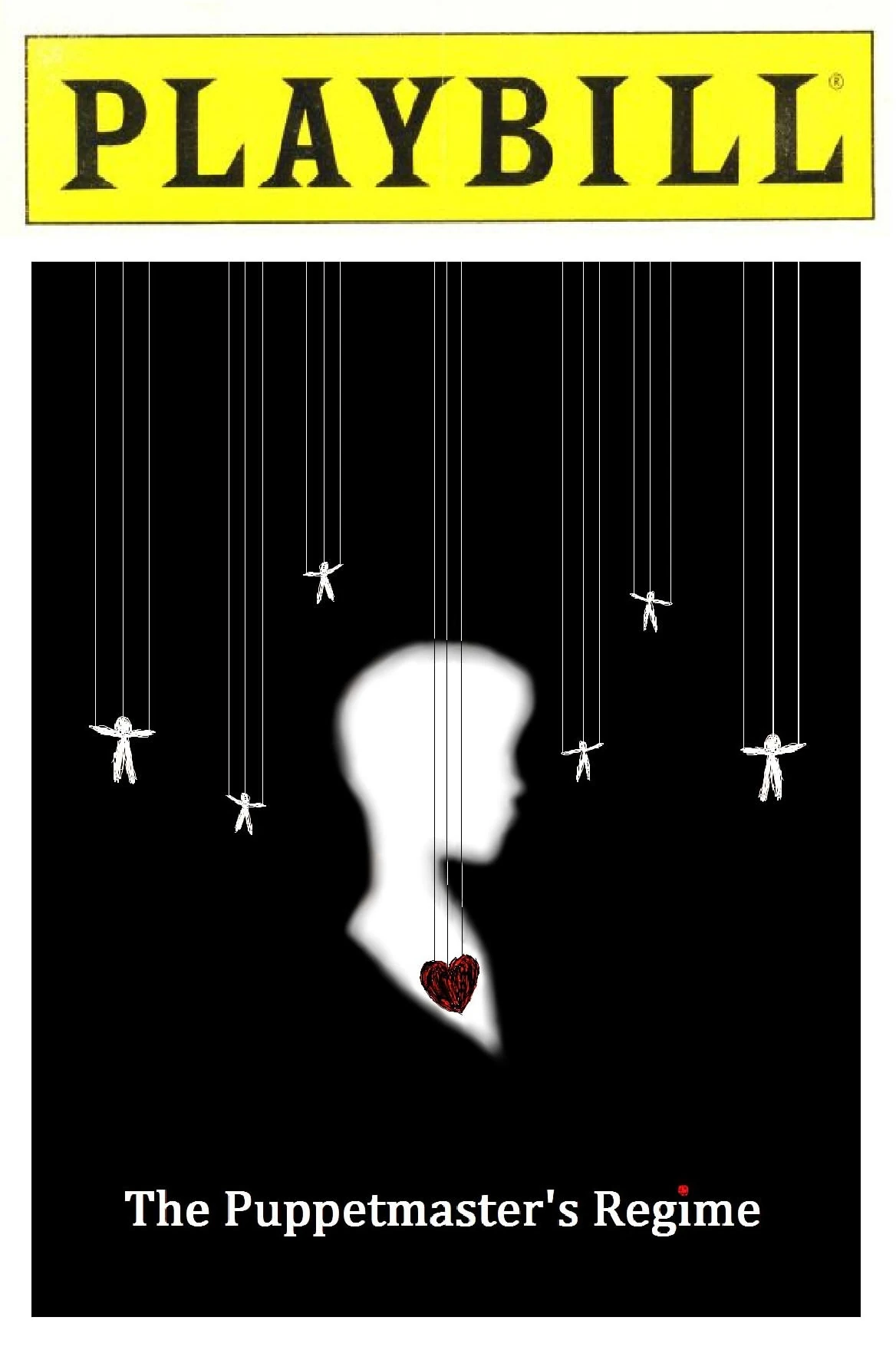
Upon entering the theatre, I was given a playbill by a cheery man in a suit - an older gentleman with a weak smile on his face. The playbill itself showed the white silhouette of a young boy, several puppet strings attached to a scribbly red-and-black heart that hung within his chest. There were white dollies hanging all around him. I remember thinking it was odd that a preview playbill would be in color, as those aren't usually printed until the show starts making money. Anyhow, I made it to my seat and began to read through the playbill itself. I didn’t care much about the names of the cast members, though I do recall seeing the picture for the boy playing the part of Morietur: a fourteen-year-old named Milton Holiday.

The show opened to a long, plodding overture - played mostly with piano, with these odd whistles being played through speakers all around the theater. After about five minutes, the music changed to a more bouncy, lighthearted tune, and the curtain came up.

The stage was empty, nothing but the projected backdrop of a village square, with these odd clouds floating above. About ten children in eighteenth-century German clothing skipped onstage, playing with balloons and dolls. As the music progressed, a small mechanical horse wheeled itself onstage. The lights dimmed, and the children stopped. The horse dragged along a cart, upon which a small curtained puppet box faced the audience. As the cart came to a stop, a large puppet in a black robe flew out from behind the curtain. The children screamed, and backed away.

Then the puppet spoke:

“Good day, little ones! What a wondrous day for bout of play, isn’t it? Now don’t you be frightened, sweetlings. The Puppet Dressed In Black has a tale to weave, and someone has to hear it. Why, even if a story isn’t terribly uplifting, it’s the relevance of the story that matters, isn’t it? Now gather, gather, my popinjays… for this story, I’m afraid, requires the keen ears of a curious child. For only the innocent can see things simply, without the distractions of growth.”

The children looked at each other, then slowly began to gather around the cart. Once they were all seated, the Puppet let out a chilling laugh.

“That’s the spirit, kiddies!” he sing-spoke. “Now, this is a story about many things…about love and hate, about dark and light…about the difference between right and wrong, and the difference between wrong and right. But, at the core, this is a story about a little boy named Morietur…”

And with that, the light on the cart fades away, and a light fades in on a small boy, holding a broom, smiling proudly. Morietur.

The rest of the prologue is rather bland, and I can’t remember (or decipher the audio to) much of the exposition. The Puppet, Morietur, and Mr. Obiscer share a song. We learn that Morietur was an orphan who Mr. Obiscer found on the side of the street five years ago, and has since put him to work in his puppet shop. The costumes from this point seem much less historically accurate from the opening scene. Everyone’s costumes seem faded and bland in color scheme, but each of the outfits are ridiculously frilly and layered. Some of the story’s exposition is changed. For example, Morietur’s last name; ‘Abinces’, had been reapplied from the novel on which the story was based.

The staging and set design is oddly reminiscent of Andrew Lloyd Webber’s The Woman In White…most of the sets are made up of hyper-realistic projections that give the illusion of a moving camera. However, unlike The Woman In White, there are far more set pieces which actually have moving images projected onto them - like the revival of "Sunday In The Park With George."

For example: During one of the opening songs; “I Can Hear Them Whisper,” we see Morietur sweep up around the puppet shop. We watch as the front desk and two puppet display shelves spin around on the turntable as the projected background spins slightly faster, adding in ominous shadows and subtle lighting changes. It was dizzying, but effective.

Most of Act I’s exposition seemed rather harmless in my opinion. It almost seems like the start of a Disney show. However, I did find my inner critic rolling his eyes at some of the puerile lyrics (my personal favorites being: “He pretended he was crying/though they told me he was lying,” and “He was a sickly boy/Knowing not of ‘joy’”.)

However, upon comparing the new version to what I’ve heard about of the other two; there are some significant changes to the show.

For example, The character of Madame Reperio has been cut completely. After the cutesy song “Get A Puppet”, we are taken to the center of the village. Here, we have one of the songs that had been cut in previous versions, entitled “Whitteltine,” in which the villagers celebrate a holiday of the same name. This celebration focuses on villagers dancing around with puppets and dolls made out of random objects such as twigs, scraps of clothing, and cornstalks. The music is charming, like a folksong… although the lyrics don’t seem to make much sense:

“Dancing as we pither through the withering and woe-!

Evermore aligned along the ever-growing row-!

Eyes without a trace of tones or livelihood and so-!

Rise and rejoice for a Whitteltine song…!

And the willows will wander all Whitteltine long…!''”

Here, the song where the children sell dolls is used as a bridge in the “Whitteltine” sequence.

Another change is the rearranging of “The Wind and the Whisperings”, a song that a was originally played in Act II. In this new version, it is sung monotonously by a group black-clad people mourning the loss of a young girl, a rape victim. The sequence itself is so strange… around eight people walk onstage, four of them carrying a small open coffin. The lighting goes from yellow-orange to blue, and the chorus drones on for about eight minutes as they somewhat explain how this girl died:

“''The wind was her muse for play…

And she pranced along the river way…

She slipped along the sides of the weeping willow’s hairs-

And she danced along the river way with nary a remorse.


The whisperings from far away…

Calling out for her to stay…

She stayed there with the wind and the whisperings of yore-

And she danced with him until he saw fit to take her source.''”

Again, this uncomfortable ensemble song goes on for about eight minutes. From what I could assume, the little girl had been playing along the river when a man asked her to stay with him until nighttime, where he raped her and tried to drown her before a policeman stopped him right as the girl had perished.

Other than that, most of Act I seemed the same as the other versions. Given, there is a small bit where a girl with a puppet mysteriously appears and disappears while Morietur sweeps up the shop, and a random scene right before the finale in which Mr. Obiscer sings about the hardships of raising Morietur. (A song reworked from the same song Madame Reperio sang in 1934.)

The finale’s song itself, which so many people had claimed held some sort of “force” to it in the 1934 production didn’t seem all that powerful. Though this may be due to a rewrite: the 1934 version was said to be significantly longer than the 1928 workshop, at around twelve minutes of nonstop gibberish lyrics. This version has a reprise of “The Wind and the Whisperings”, followed by a few versus told through the odd language. The lyrics are, in fact, somewhat odd-sounding after two minutes of nonstop strobe-lighting, but I wasn’t that affected by it. There weren’t any deaths after the finale, at least…though intermission did last ten minutes more than it was supposed to, due to technical difficulties backstage.

Act II was where most of the changes seemed to be. It began with a light on Morietur being strung up on ropes like a puppet, his friends and Mr. Obiscer hanging on either side of him. A new song plays where all the songs from Act I are placed into a montage, while the Act I Finale music plays in the background. Just as the music shifts to the pounding “Whitteltine” music, Morietur awakens.

Remember when I mentioned that Act II was mostly made up of a bunch of songs played one after the other for no apparent reason? Most of that has been cut. The only two songs from that long, drawn-out sequence are “What Is This Place?”, and “Morietur’s Soliloquy” (which has been renamed to “Morietur Confronts the Puppet”, and has been changed to a duet sequence.) The lyrics have been improved, as well. Whereas the 1934 show had lyrics such as this:

“What is this place?

What are you aiming?

This isn’t well, sir-

Why are we gaming?

This isn’t a game!”


The improved lyrics are:

“What is this place?

Wait, am I dreaming?

This isn’t real, no…

Nor what it’s seeming…

It’s all a dream!”

Still a bit clunky, but at least they make sense now. The particular scenes I listed before involve a panicking Morietur confronting the Puppet Dressed in Black, who explains that Morietur’s soul once belonged to a child rapist, and that he died before the Puppet could punish him. This is where the set designs became a bit… odd. There were several floor-to-ceiling metal dollies that would constantly roll about onstage, as if to symbolize Morietur walking somewhere. The backdrop went red, and there were projections of puppets flinging the corpses of children along the walls. To say it was unsettling would be an understatement.

After this, the story progresses in a similar manner as the 1928 workshop, but with different twists. Morietur learns that the odd-looking man in black from the first act was the boy that Morietur raped in a past life. The man in black wants to revisit their relationship, but Morietur wants nothing to do with him. They spend the next ten minutes singing about what might have been, and Morietur begins to remember things. He ends up seducing and dominating the man in black, and they have sex on a bed while a group of children acrobats frolic about on long sheets of fabric above them.

Just then, the Puppet Dressed in Black shows up, and orders the old man to go away. He explains to Morietur that his punishment is to forever serve him, aiding in the future rape and murder of children in the village where he lives. As they both sing the title song, several children (including the little girl who drowned in Act I) join in, all holding miniature puppets dressed in black.

The new ending is a bit confusing, but apparently they’re saying that pedophilia is some sort of vicious cycle…when a pedophile dies, his soul is placed in that of a newborn child, who will, by fate, be raped themselves...this influences them to become child molesters in their adulthood. Morietur, as well as several other children, manage to defy destiny by escaping their respective rapists - which results in their being enlisted into "The Puppetmaster’s Regime." It makes so little sense, and it’s so damn creepy.

Then, just like in the 1928 workshop, all of Morietur’s friends are returned to the puppet shop… but none of them have any memory of Morietur.

We cut back to the cart from the prologue, where we see that all the children have disappeared. From the back of the puppet box, Morietur and the man in black exit from behind the curtains. They hop upon the horse, and begin to trot their way out of the town, As they exit the village, they hear a small girl’s terrified screams, and she lunges out in front of the cart. She begins to beg Morietur and the man to help her, just as an old man rushes out in pursuit. He insists he is the girl’s father, but she sobs that she’s never met him before. Panicked, Morietur pulls on the horse reins, and runs over the man, killing him. The man in black turns to Morietur and, his voice low, whispers, “Morietur, what have you done…?” before the lights go out.

However, right after this scene is where things quickly became… wrong. The lights slowly faded from the green tint of the forest into a deep blue, similar to the lighting during “The Wind and the Whisperings.” The entire company slips out from backstage holding their miniature puppets, staring directly at the audience.

Just then, the lights began to flash…and the puppets… I know this sounds kind of stupid to say… but they sang. I don’t mean that the children sang while controlling the puppet’s mouths - the puppets actually sang.

And oh god, the song.

It was that same gibberish from the Act I finale.

The children, the adults, all of them were holding puppets. They chanted those horrible words over and over again, their eyes unblinking, focused on the audience. Trapped in our seats, we were forced to listen to the song repeat itself over and over. I saw that the cast had begun to move the puppet’s around in jerking, near-erotic dance moves, every now and again twitching in unison with the rest of the company. After a while, I began to feel sick. We were all sick. I could see people in front of me leave their seats, ready to leave. I tried tuning the chants out, but that only seemed to make them worse. The music pounded within me, causing me to jerk about with each pounding drum. As I leached back in my seat, I realized something. The pounding within me wasn’t just from the orchestra… it was from beneath me. For a moment, I could see that everyone else could see it, too. For a faint moment, we could feel the ground beneath us quake along with the chants. I looked up to see if the cast had noticed, but then I saw the puppets. They were still dancing and moving within the performers’ grasps… but the performers themselves were not moving their arms.

And then, for a moment, we all found relief.

From backstage, several crew members rushed onto the stage, pushing several actors away in the process. One of them screamed out “Fire! Shit!” and then the chaos began.

From above the stage, all the lights began to shoot off. The projections behind the actors flickered briefly, before shutting off entirely. The company screamed, as did the audience. In a flash of fire and sparks, the actors began to leap off the stage, and we all began to pile out the door. I still had a headache. I could still hear the pounding.

The fire department arrived shortly after the theater was evacuated. About ten minutes before the trucks arrived, we heard the back of the theater collapse. I’ve since checked the articles online, and sixty-plus attendants of that show (nine of them being the cast and crew) have gone missing. As it turned out, most of the people who didn’t leave the parking lot were either helping out (like me), or were too shaken up to drive. When I finally began walking towards my car, a gurnee was wheeled right past me. The man I saw laying there, unconscious and hooked up to an oxygen tank, was the same man who had handed me the playbill.

I drove back to my friend’s apartment and went straight to bed. Even in my sleep, I could still hear the pounding.

By morning, my headache had stopped, but the memory of the night before still lingered. I went to my computer straight away to upload the audio I had recorded. My camera tends to divide long videos into smaller ones, and I immediately deleted the last video. Nobody ever needed to hear that…especially not me. I listened through the recording again, making notes in Word Processor as I went along. I found myself humming to some of the more bouncy tunes, the pounding slowly fading away. My fear of the show had lessened. The idea of supernatural forces destroying the theater seemed far too ridiculous for me to take seriously, and I bushed my fear aside.

Once that was done, I went to work scanning the playbill. After scanning the front, I went to work scanning the interior pages. A bit curious, I skimmed through some of the production names.

And it was then, right there on the third page, I saw the picture of the man who had handed me the playbill. The man was the Head Producer/Director, I learned. A cheery old man with a wrinkled face, looking away from the camera. Below his picture, in bold letters, read the name: Timothy Cartwright

My face scrunched. My breath went still. All I could hear was the faint memory of the pounding. That isn’t right, I told myself. It isn’t possible. It’s a different person. It had to be. Timmy Wright died on October 1st, 1935 at the premiere of The Puppetmaster’s Regime. Everyone saw it. Everyone saw him begging for help, strung up on strings - this isn’t possible.

Then I remembered something.

In my interview with Alice Corley-James, she mentioned Morietur’s “squinty eyes,” and his “monotonous acting.” Timmy Wright was known for his wide-eyed expressions and over-the-top delivery. It’s what made him famous. The person performing Morietur that night in 1934 must have been Rory Atkins, the understudy.

That, and Garris Creely had been found dead - killed by a gunshot to the head. Everyone assumed it was suicide. Nobody even suspected murder. I remembered Devin’s journal - the puppet mask, the clothes, the fascination Garris Creely had with little Cutie Wright. Nobody even suspected murder. Why would they?

And then, to add to my revelation, I realized that among the cast members who had escaped from the theater, there was one boy sitting in the backseat of his mother’s car… the vague, empty face of Milton Holiday. Morietur.

"The Puppetmaster’s Regime" is not a simple musical, I’ve come to realize. It’s more than just a production. It’s a force. An entity, even. It’s not just a madman’s sick, elaborate scheme to rape his own son… it isn’t just a young boy’s obsession over destroying his father’s work…it isn’t only an innocent victim’s last attempt at showing the world how he was wronged… it’s a greater monster than that. Within the writing and music of this show is something… I don’t know what, and I don’t want to know what. Some kind of monster that refuses to die. People who saw "The Puppetmaster’s Regime" in both 1928 and 1934 were said to have suffered from life-long mental affects, causing them to hum tunes they had heard only once.

Even now as I type, I quietly hum the sick, demented tune of “Never mind Me, Mister.” When I sleep, “The Wind and the Whisperings” refuses to rid itself from my subconscious. I find myself thinking about this production night and day, singing and thinking about possible depth to certain subplots and songs. What’s worse is that I know that someday another revival of the demented work will make it’s way onto the stage… Milton Holiday is still alive, isn’t he? And this evil won’t rest until it remakes itself again.

I’ve decided not to post anymore of my findings - this includes the audio taken of the revival. And I suggest that none of you attempt to look further into the matter. It simply isn’t worth it.

****

UPDATE: September 27

A few days after writing this I read a few articles about the fire at the theater. Those sixty-plus missing people? The Fire Department has been searching through the rubble. None of the bodies have been found. 

---

Credits


The Puppetmaster's Regime (Part 2)


When I last broached the topic of the 1934 musical “The Puppetmaster’s Regime”, my knowledge was apparently very limited. I had originally believed that all of the audience members who entered the theater on that fateful night were deceased, but I was incorrect.

One lone audience member, Alice Corley-James, who was nine years old when her grandparents took her to see the show, lives in Connecticut with her grandchildren. I gathered this information after my long investigation as to the theater which housed the unfortunate events of 1934.

I found myself on a wild goose chase after a long line of theater owners shoved me in different directions via emails or the rare private meeting. I was eventually given the home address of a little old man who shall go unnamed. This man had worked in several theaters over the past fifty or so years, and had collected many “borrowed” theater items.

One of these items was a box labeled “34-Creely/Wright”. The gentlemen claimed that he found it in the vaults of the August Wilson Theatre, but I’m not sure if he can be trusted, as his eggs seemed to be in quite a few baskets, if you understand me.

The oddly numbered box contained several sloppily organized papers, all of which detailed the long-awaited production of “The Puppetmaster’s Regime.

The most interesting of these files was a bulky folder that detailed the 1928 workshop in London, where the title of the show was originally “Morietur’s Friends”, which was later changed to “Morietur’s Puppet”. As music was refined, however, the title became “The Puppet Dressed In Black”, and was finally changed to “Puppetmaster”, which was the title they used during the actual staged readings.

The folder also contained a partial script for the show, although many pages appeared to be missing. None of the song lyrics were shown on the script, although the song titles were printed in their place, along with notes for the young actor playing the part of Morietur. Most of the notes are from the director, a man named Richard Webber…but one particular note seems a bit ominous:

“A little less vibrato on this one, Garris. Make me proud. Make us both proud. ~Mr. Sheridan”

This ‘Mr. Sheridan’ never showed up on any of the other files. He may have been an unaccredited assistant director, but something about his handwriting didn’t sit right with me.

Anyhow, some of the song titles are rather fascinating. Tunes with such titles as “Never mind me, Mister”, “Morietur was an Orphan”, and “Get A Puppet” make the production seem like any other. The characters don’t seem to be written in any strange way, much to my disappointment. It seems like a harmless little kiddie show, cutesy and upbeat. However, as the script progresses, the notes from this ‘Mr. Sheridan’ become more evident, and his messages become increasingly disturbing:

“We loved it the way you used to do it. Stop doing what we never told you to try.”

“Your cheeks puff at the end of this number, Garris. I love it. He loves it. We both love it. They love it.”

“Meet me backstage after the reading, Garris. He has a gift for you.”

“Meet us backstage again, Garris. They love to look at you.”

“Never leave us, Garris. You’re too important to Puppetmaster.”

After reading up to the scene where Morietur and his friends try to sell dolls (creatively titled “The Doll-Selling Song”), I decided to stop reading and do a bit of research on Garris Creely. I was not prepared for the sickening results:

Garris Creely was born on November 3, 1916. His mother had been a vaudeville stripteaser who lacked the funds necessary to support a child. As a result, he was taken in as a three-year-old by a man whose last name was Sheridan (His first name is recorded differently in many documents. Most people believe it to be either Carmichael or Charles.)

Sheridan was apparently a Coney Island architect, who designed elaborate funhouses and carnival freakhouses. He was also a private composer, having written many vaudeville numbers and Coney Island themes. Garris Creely-Sheridan was a semi-popular vaudeville performer from 1921 to 1923, upon which he was removed from the Sheridan home after Garris claimed to have been sexually abused by his adoptive father.

Garris was taken to live with Annabel and Henry McGregor, a middle class family living in upper Manhattan. Annabel and Henry, in an attempt to rid him of his childhood trauma, relocated to Worchester, England, with Henry McGregor’s relatives.

Coincidentally, “Puppetmaster” began rehearsals for the workshop a year after Garris Creely moved to England. The music and lyrics were still accredited with ‘anonymous’.

Now, one might assume that this is just another depressing backstory to a child performer from the early nineteen-hundreds…but it gets worse:

(unknown) Sheridan, along with being an architect and composer, was also a great patron of child pornography. He was the leader of a small group of individuals who specialized in the production of such articles. What makes this more revolting, is that from 1921 to 1923 (the years that Creely was his legal son), Sheridan housed a child-centered burlesque theatre/brothel underneath his estate. In 1924, he was placed in the Danvers State Lunatic Asylum in Massachusetts and escaped in 1926—a year before rehearsals began for “Puppetmaster”.


Now, returning to the script for “Puppetmaster”, we actually have a tangible record for both the end of Act I, as well as most of Act II.

The actual ending for Act I (as it was written), was as such:

Morietur and his friends design a puppet exactly like the one that Morietur has seen in his dreams (This was explained in a song entitled “The Puppet Dressed In Black”, which I assume was cut in the Broadway production). This puppet then comes to life and calls upon his magical powers to send Morietur and his friends into a parallel universe.

Act II begins with Morietur finding his friends (as well as Mr. Obciser), to be ‘asleep’, and dangling from puppet strings. The musical takes a more operatic theme, as we have six songs that are played one after the other, without a single interval of speech.

(The song titles being “Never mind Me, Mister (Reprise)”, “I Can Hear Them Sing”, “What Is This Place?”, “Morietur’s Soliloquy”, “Wooden Dolls”, and “The Wind and the Whisperings”.)

After this, Morietur is confronted by the odd man in black from the first act, who, in a long monologue, explains Morietur’s deep, passionate, sexual longings. Morietur realizes his clandestine emotions in a song entitled “Beautiful Music”, in which the man and Morietur apparently fall spontaneously in love, and right before they allude to the thought of intercourse, the Puppet Dressed In Black appears, jealous of Morietur’s affections. Morietur strips naked in front of the puppet, allowing for the wooden demon to seduce him. Morietur offers his soul in return for the Puppet releasing the ones closest to him.

When the children and Mr. Obciser are returned, the Puppet Dressed In Black and the old man reveal their sole motivations: to punish little children who repress the nature of their sexual responsibilities. They explain this in what would eventually become the show’s title song; “The Puppetmaster’s Regime”. Then, in a spout of randomness, the Puppet’s face turns bright red, and he shoves Morietur onto a bed shaped like a hand, apparently raping him.

In the epilogue, we see that Morietur’s friends have all been returned to the Puppet Shop, but none of them remember anything about him.

As you would assume, the workshop didn’t do well at all. Anybody with half a brain could understand why a musical about why children are obligated to have sex with adults and puppets wouldn’t work now—let alone in 1928. It was met with such a terrible response that the authorities forced the workshop to shut down, classifying it as child sex tourism. Garris Creely was temporarily removed from the McGregor household, for their approval for allowing him to participate in the production (when in reality, the cast members were contractually obligated to never speak about the show to anyone outside the production.

A week after Garris returned to the McGregors, he was kidnapped from his bedroom. This all happened the day before his birthday. After two days, the authorities found Garris at the theater that had been holding the workshops. He was found in the basement of the theater, tied to a bed, being violently raped by Sheridan. Sheridan, of course, was taken into police custody, where he died two days later of a lung infection. However, the most disturbing part about the crime scene was described by Officer James Cartwright:

“We broke through the door, and we were all fumbling down the stairs. We could hear him [Creely] screaming…we charged into the basement and saw…puppets. Puppets everywhere. All of them made to look exactly like the little Creely fella. There had to be dozens of them all over the room. Some of them were neatly dressed, like little dolls…others didn’t have any clothes on at all. It was so disgusting. I feel sick just thinking about it.”

Along with the recorded seventy-six Garris Creely-esque puppets that were found underneath the theater, authorities also found several articles of the occult in Sheridan’s makeshift apartment. He had apparently begun to worship an ancient god he called “Podominus”, a dark spirit who controlled all of life with invisible puppet strings.

Most of the investigators believed that Sheridan had created this God himself using the surplus of insanity he had retained by the time of his death. They also found a 5,023-page novel that Sheridan had written over the course of the past nine years, entitled “Puppets”. It was an extended manuscript version of “Puppetmaster” that was centered around the character of Morietur Abinces, a character obviously based on Garris Creely.

Following the events of “Puppetmaster”, the McGregors admitted Garris Creely to the West Riding Mental Hospital (now known as the High Royds Hospital) in order to repair his obvious mental damages. He was supervised by his adoptive uncle; Doctor Gregory McGregor, who personally documented his progression from 1928 to 1932, when he was released.

Other than the folder containing information for the 1928 workshop, most of the documents present in box “34-Creely/Wright” are mass jumbles of different documentations. Everything from vague police reports to scathing reviews of the workshop, and none of them are in any particular order.

The only valuable document I’ve managed to find is a list containing the names of all the audience members who attended the 1934 Broadway premiere. Seeing as how Alice Corley-James is still alive—and was seated in the fourth row of the theater—I hope to contact her soon in order to continue my investigation. 

---

Credits


The Puppetmaster's Regime (Part 1)


Have you ever heard of the musical "The Puppetmaster's Regime"? Most likely, you haven't. In fact, most die-hard theatre lovers are often unfamiliar with this little production. It was a 1934 stage musical written by anonymous authors of the music, lyrics, and book. It starred upcoming performers such as Timmy "cutie-pie" Wright, Sally Wilkes, Henry Gregory, as well as many others. At the time, it was the most expensive show to date. It was said to be the biggest, most spectacular stage show to San Francisco and back.

From the testament of Tyler Warwick (1901-1983)

"I went to see the show about a week after I turned thirty-three. The ticket was a gift from my sister, who knew how much I loved the theatre. I remember the signs, they were huge and rather gaudy. Oh, and the playbill--it was just a single red dot with a doll-like face on it. It seemed a bit melancholy for what I assumed was to be a musical-comedy, but I didn’t pay much attention. I was going to see a Broadway show."

From the testament of Georgina Long (1911-1984)

"The cast was made completely of 'new' people. Young children and adults alike who were longing to get back on stage after Vaudeville became old news--it was quite charming really. But I did take a bit of notice to that odd little playbill...all the playwrights and lyricists and everyone were all unnamed, and that design...it was a little red drop with a peculiar little face in it. Not even a title, just that little red dot. I had come to New York with my parents on an impromptu vacation after my grandmother had died...a Broadway musical seemed just like what we needed. (…)"

From the testament of Carl Hannigan (1920-1993)

"I do recall most of the first act. Then again, who could forget? The story was a little hard to follow at first. There was a little boy who lived in a puppet shop, or maybe he lived down the street--no, no, he worked in the puppet shop, but he was homeless, so they provided him with a home there. The kid's name was Mori..Mortim...something weird...oh yes, it was Morietum...no, Morietur. Morietur, yes.

Anyways, Morietur's employer was this old man named Mr. Obcisor. I remember his name because his character was unimaginably unsettling--bouncing all around and getting angry and the little boy, all while keeping this nasal, gigglish voice. Anyhow, the production opened to Morietur and the odd fellow getting into an argument over the boy not doing his work, then two of them sang this peculiar number about puppets...it wasn't a normal song...or at least, the musicality wasn't normal. The lyrics were very enchanting, and the music did this odd flowing thing about the room…instruments would get very quiet without losing any power to it; maybe it was just the acoustics--I'm most likely explaining it all wrong. Oh well. But...in time, we got used to it, and the show progressed..."

From the testament of Gabriel Johnston (1919-1976)

"This youngster, Mori- Morietur, something like that, was quite insecure about his stay in the puppet shop--very paranoid that his boss would throw him out. I was an aspiring lyricist at the time, and I'd done the lyrics to a few original community theater projects, so I was fascinated with the wording in these songs. I scribbled down a few lyrics after I’d went home. Unless I'm remembering wrong, the little puppet-shop-boy and Mr. Obi-something had a introductory duet, and then Morietur went off and had a short lament in a different, much more somber tune:

If I stay, and do everything right I can live in the day, and steer (stay?) clear of the night
Out there in the night, in the dark, there’s a world of why’s (lies?)…
I can hear them whisper…
And sometimes I can see their eyes…

The ‘eyes’ comment confused me for a moment, but then I assumed that he was meaning the stars. It seemed as though the number was unnecessarily tragic and poorly situated within the show, but it was a minor quibble.

Now, Morietur had a girl friend named Trahunt and a boy friend named Adolebit. After interrupting the final note in his lament, they all gushed about how much they loved puppets...but they couldn’t afford one from Morietur’s guardian’s shop, and so they transitioned into this vibrant little song about joining forces to raise money so they could afford to build their own puppet. After this, the three all headed for school, and the story took a sharp turn in a different direction.

(After several attempts to begin again) Now...they had this really nasty teacher or headmistress named Madame Reperio, or something like that. They had a reprise of the song from before and she overheard them, and at first her remarks about the children's fantasies were somewhat comical...but then the light fixed on her and she sang this heartbreaking little song. What the song was about was up for interpretation. It was somewhat about love, but it had all these strange puppet metaphors. The only lyric that’s stayed with me is ‘Stroll through the wood-cracks, show them your pains/The hole in your throat and the strings in your veins’

Then, she just went on this little breakdown--I assumed it was a poorly-conceived character trait. She started singing off key and went to beat one of the kids. The curtain fell, and there was a scuffle heard onstage. People whispered to each other, but a rising new orchestra piece silenced us. The curtain rose again, and we were right outside the puppet shop."

From the testament of Louis Roberts (1905-1967)

"Morietur and his friends went into the town and sang a song about selling...dolls, I think it was. Because the little girl made dolls in her spare time, and she had to sell them. I remember those strange background characters. The company was so absolutely monotonous...they all wore some form of dark clothing, and each of them were very, very tall. I can remember how they all had their faces covered up by hair or hats or veils...none of them spoke. None of them even sang during the course of the show. They just walked in perfectly straight lines, as if they weren't even part of the production. Anyways, this strange song about buying dolls...it had absolutely no life. But for some reason, these children were putting their all into it. I could see the pain in their faces as they hit those high notes. And something else...as the lyrics went on...they seemed to...get...a little...it is so hard to explain. They all looked like they were...hurting a little. They looked so pale and nervous all of a sudden. Coming from a stage family, I convinced myself it was only stage-fright, but it still made me just a tiny bit anxious."

From the testament of Carrie Laurie (1921-1995)

"The kids all got their money from this strange man in cloak who sang a simple little tune...I still remember the lyrics:

Despite the fall of rain, little kiddies,
Everyone needs a little song-
Wooden dolls give you pain, little kiddies,
Go on, little kiddies, run along...

His character was never really explained. But I remember how truly gripping the melody was...so haunting, it got you right there in the gut. Even the little kid actors seemed a bit unsettled by the new turn of the show. They all kept stuttering over their lines as they spoke and sang, and then a light bulb over the stage went out. Everyone kind of gasped and one man I think even laughed. The noise it made really spooked the little girl, little miss whatshername. All the names were so very strange. All I know is that light bulb had gone out, an the actors were stumbling across the stage...and the whole thing looked like a terrible flop.

When the children reentered the puppet shop, they presented Mr. Obcisor with the puppet pieces they’d acquired when the audience wasn’t looking, singing a braggedy sort of chant, ‘we done/we done/diddy-diddy done-done did it!'. It was obnoxious, but thankfully brief. After that, the light fixed on Morietur, and he began another tune. The song was a dud, and all I remember was that he flubbed the last line. The lyric had something to do with 'the final stroke of light', or some sort of long-winded moon-based metaphor. All I know is that he forgot the words, and all that could be heard in that theater was the sounds of car horns outside the building. The boy...he didn't seemed shocked or embarrassed or nothing, but his posture improved out of the blue, and the orchestra stopped. He projected half of the word ‘sorry”, then suddenly he burst forth in wordless vocalization. The music resumed, and the other characters began to join him.”

From the testament of Marcus Edger (1918-1968)

"...So After that bulb went out, the whole set started falling apart. We, the audience, tried our best to ignore it. But it was near impossible. I saw two sets of very angry attendees get up and leave. The set piece for the puppet shop screeched its way onto the stage, and we could see in the far back the paper sky background falling down. The lights went dim in what we assumed was an attempt to hide the malfunctioning set pieces. The kids, with the help of an oddly monotonous Mr. Obcisor, constructed the puppet...and this strange song played. To this day I don't know what they were saying. It sounded vaguely like Latin, but I went on to study Latin in college the next year, and found that guess to come out flat. I remember how it enchanted me, though. It enchanted all of us. We all began to feel this...thing...course through us. I remember a few people around us who were humming in an attempt to rid themselves of the sound, and I could hear people in the front rows crying out in what sounded like pain.

The actors themselves sounded as though they were about to pass out at any moment. They were doing this odd sort of ballet and they were tripping all over themselves, and a few more lights started flashing and breaking. We all sat and waited for the song to end, when...when...I'm sorry. (pause) I'm so sorry...I can't..."

From the testament of George Frank (1899-1999)

"...The lights were going on and off at random, and we were all praying the damn song would end soon. It had this force going with it...it was sucking us in. We could feel it. The little kids and the puppet man were dancing all around when...well, you see...(pause)...I really thought I could do it. I thought I could do it...I was right there in the fifth row, so I saw…but I can't..."

From the testament of Carolyn Mark (1901-1949)

"...The lighting was completely out of control. It was a mess. And that song...it was awful. But something about it...it was powerful. It had a force. I watched intently as the dancers began to skip around and...and...we...I thought they were...the lights..."

Conclusion

The actual events of the final scene of Act I of "The Puppetmaster's Regime" has been up for debate for many years. Not many people are willing to speak out about what happened on stage during those final moments. Many believe that there is no actual record of an interview with somebody who was willing the tell the story…this is not true, as one testament survives from a Billy Prescott, who was only six at the time of the show. At such a young age, one might assume he was less affected by what he recalls happening:

"...I was just a kid, so I don't remember much. All I can vaguely recall is that song...it was giving me a headache. I turned to my father to ask him if we could leave, when suddenly I saw the stage illuminate with this bright red light. The music stopped as one instrument after another died out, and swear I heard pounding underneath the stage. Everyone was questioning what was happening...even the actors. I remember that teacher lady being pushed through the door of the shop...and then everyone else came flying in from offstage, toppling on top of each other like rag dolls. There were people there who didn’t fit the design scheme of the production--stagehands and technical workers, I assume now. I remember the little girl screamed at the audience, then ran behind the shopkeeper while other actors continued singing. A few people started crying right there on the stage when suddenly this...curtain...came forward.

It's hard to describe what it looked like. It was a clear plastic wall, and it came down from above. Several years later I saw "Carrie: The Musical" on Broadway during one of its few runs...that thing that came down on the promgoers when Carrie was using laser lights to kill everyone? It was just like that. A bunch of set pieces from earlier scenes came down on the sides of the stage, trapping all of the actors in the center. Then chaos erupted.

The actors stopped singing, and were pounding on the plastic wall. Then, for some reason, they began to back away. As if some unseen assailants were coming towards them, they fled to the back of the stage--all except the little boy. The little boy who hadn’t stopped singing. Then, amid all that screaming and crying and shooting, the curtain flew out, and everything was in silence.

Due to that odd abruptness, the audience thought it was just a horrible ending to a terrible musical. We were about to get up when suddenly the curtain opened up again, revealing the stationary plastic wall upon which was a single light fixed on the little boy, Morietur. He had clawed his way through the plastic wall...we could see the blood on his hands...but…(pause)…the way he looked was…(…)

There were strings attached to every part of his body. We could all see his stomach...or lack of, anyway. It was like somebody had put a huge ice cream scooper in his belly. He was sobbing all over the stage, twitching and swinging around. It was a sight so unnatural looking, so painful and twisted and wrong...even now, I can't seem to wrap my head around how, but...(pause)...and so...and so everyone looked at him, not knowing what to do...and then he spoke...

"Help me...please...help me..." was all I could make out, and then he vomited and suddenly collapsed. The plastic wall lifted, and lights all came on. We saw the rest of them.

They were all dead. Every one of them looked exactly like the little boy. Everyone had those strings attached...and we watched as all of them, even the little boy...as their strings were pulled on. Their lifeless bodies rose on cue, and they bowed."

However, we cannot be certain that this a credible account...but unfortunately, it's all we have to work with. "The Puppetmaster's Regime" sparked horrible debate among the theatre companies. Several audience members had to be treated to special therapy for years to come...and the show itself was covered up by the police. For years to come the theatre company, as well as the police department, who had never managed to solve the gruesome murders of the cast and crew of the show, denied that the play ever existed. However, in recent years the story has resurfaced...sparking much new debate on the subject.

The theater that housed the musical still refuses to acknowledge the show's existence, and most theatre historians know nothing about the show in general. To this day, the identities of the anonymous lyric and music writers are unknown, and (to our knowledge) all recordings of the songs and police reports have been destroyed. However, through certain pieces of historical documentation, we can gather a bit of information on the production: The show itself had its first workshop in London in 1928. One of the songs, "Get A Puppet" was recorded with vocals by twelve-year-old Garris Creely. However, this recording has been lost, but is supposedly available in the black market of the internet. Other than that, no official records were ever made. Some ancient accounts say that an illegal audio taping of the final scene of Act I was recorded from backstage, but we cannot be certain that this is anything but a rumor.

As for any official memorabilia, very little of anything has survived. Until her death in 1994, theatrical historian Gladys Masters kept two large-scale posters, which she displayed at charity events--but these have since disappeared. Early costumes by Alice Lively, who had been the costume designer on Puppetmaster until she quit after payment disputes, are on display at the Pickett-Dahny Theatrical Museum in Dover, England. Other than that, playbills from its premiere night were given out, but most audience members destroyed their copies after seeing the show. Legend has it, around ten to twenty survive.

On another note, over the years the show has grown a small cult fan base, and here recently, an off-Broadway revival has been scheduled to premiere soon. 

---

Credits

I Talked to God. I Never Want to Speak to Him Again

     About a year ago, I tried to kill myself six times. I lost my girlfriend, Jules, in a car accident my senior year of high school. I was...